

For all its charms, there’s evidence AI is isolating today’s students. Can we figure out a way to prevent this silo of attention and disconnect from peers? Or can we do one better, and use AI to foster connections and surface unseen affinity between students?
Educators like Ethan Mollick have noted that students are no longer raising their hand in class because they can just get answers from a chatbot. AI seems to be accelerating the isolation many students in high school in college got used to during the Covid epidemic.
A number of recent projects have attempted to turn AI into an engine for connecting students, notably the PAIRR initiative that juxtaposes feedback from peers with feedback from a chatbot. Others include Sway, a project to encourage civil discourse in which a chatbot mediates a conversation between students with the posting opinions, and CollaborAITE, a project by Greg Nelson’s lab to create a Slack-like alternative where student collaborators can evaluate the outputs of LLMs in the same chat.
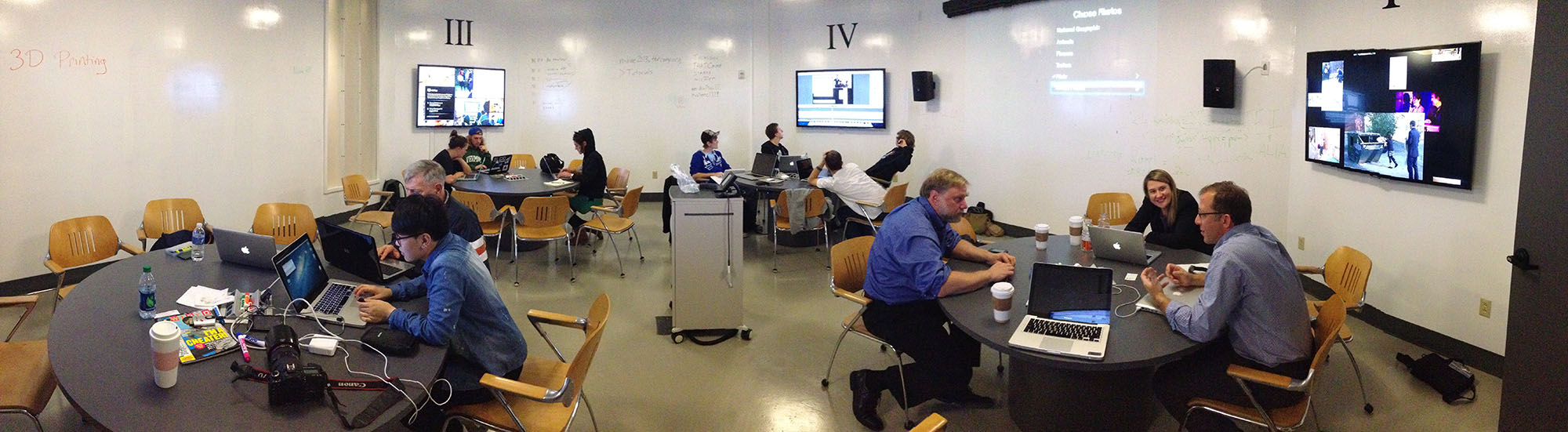 I wanted to see if AI could tackle a different problem, one that has stumped me in my undergraduate classes for the past two decades. The University Of Maine’s New Media program itself on project oriented classes students frequently collaborate in ad-hoc groups. I’ve tried assigning teams randomly or letting students create their own teams. In most cases, neither produces productive teams.
Productive teams require two kinds of relationships. One is correlations. Students with similar interests will obviously enjoy working with each other and be more informed, cohesive, and motivated when they have a choice of the topic and medium. An even more important correlation is schedules: if students have no common time to meet, the team will fail.
Match-making exercises often overlook the opposite consideration: factors that need to be anti-correlated. Team roles are an example. “Idea people” may do great at brainstorming proposals and even come up with some brilliant concepts, but if none of them knows how to build anything, their project will get nowhere. Conversely a team of only designers and coders may waste hours wracking their brains. (“You got any ideas?” “Nope, you?”)
When I first decided to tackle this project, I asked students to come up with their own systems. Despite my programs emphasis on digital media, my favorite design to emerge from the student brainstorms used paper index cards. Each student took one card and wrote a random word to represent themselves on the back of the card (to prevent student volunteers from picking teams with their friends). They then cut out notches with scissors in the sides of the card as directed in the diagram.
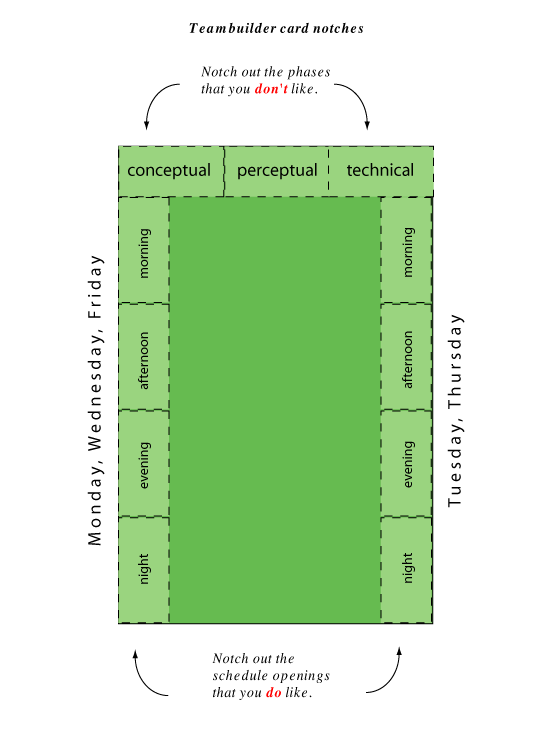 Notches on the left and right edges of the card showed open time slots: four time blocks for Monday/Wednesday/Friday on the left side, and the same four blocks for Tuesday/Thursday on the right side. If the cards for a potential team were stacked, gaps you could see through on left or right indicated common times for meeting. Here correlations were good.
Notches on the top, on the other hand, represented the three phases of a project: brainstorming, designing, and building. Students notched out any roles they were uncomfortable with. Here, too much correlation was bad: a top gap in the stack of cards meant one of the three roles wasn’t covered.
Finally, the color of each index card was a vague indicator of interest; for example, in a course building websites for clients, for example, blue might stand for the blueberry farmer, red for the lobsterman, and green for the state park.
It was an elegant system—until it came time to decide the teams, anyway. We threw all the cards onto a table and students did their best to arrange groupings so every stack had an open time slot but covered all the roles; all the better if the cards had a common color.
Frankly, it was a mess. Shuffling the deck over and over to suss out random combinations was catch-as-catch-can.
Fast-forward to last week, when I decided to try making a digital matchmaker with Claude Fable. I had mucked about with earlier versions of ChatGPT in recent years, but their context windows were so short they would just create teams from students nearby on the roster instead of jumping through all the options to find the best combination.
I fed Claude the correlations and anti-correlations from my handheld matchmaker system. After some back-and-forth, the resulting process became:
1. Giving students a Google Form that quizzes them on preferred roles, schedule, and affinity.
2. Uploading data from that form into a dedicated matchmaker app.
3. Running a JavaScript that reproduces the original algorithm – namely, randomizing the stacks, assessing each candidate team’s viability (in Fable’s case, by giving it a numerical score), and then swapping pairs of students from one team to another and keeping the results if they’re better.
4. Repeating step 3 until an arbitrary number of team combinations had been evaluated.
(Anyone who has rowed on a team will recognize this algorithm as seat racing.)
In my handmade precedent, it was hard to process more than a dozen swaps. My new matchmaker app performs 6000 on 50 students, and takes milliseconds instead of a half hour. It also has extra bells and whistles, one of which led to a dispute between the students in me the first time I tried it in class.
Fine-tuning the algorithm required deciding on a trade-off between prioritizing thematic affinities versus equal sizes. If you have six students interested in Anime but only two students interested in Kdramas, should you accept the unfairness of one team having six students and the other two, or should you separate them into a team of four Anime fans and another split between Anime and Kdrama fans?
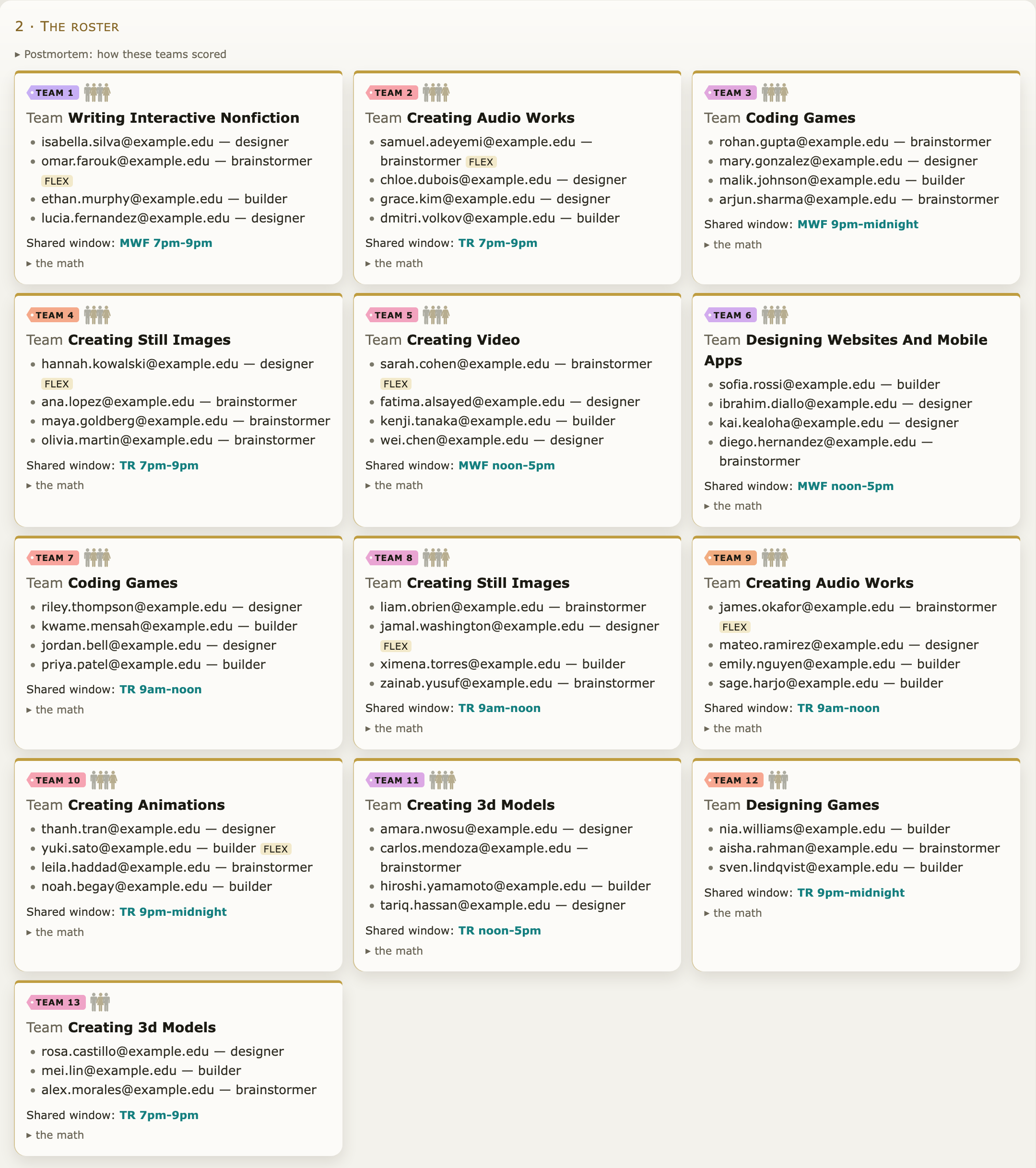 The app lets me have it both ways by generating both rosters and comparing them. When I did this for the students, they noticed the improved affinities when the teams had unequal numbers, and they begged me to let some people have bigger teams despite my objection that it would lead to uneven effort. (The desire for affinity was so strong that even students who would have been placed in smaller teams supported their peers who wanted to be birds of the same feather.)
Eventually I relented, remembering that the purpose of my teambuilding exercise was not a mathematical exercise to generate perfectly fair squads, but to promote social connections among the students.
You can clone my Google Form here and import the results into that team matchmaker app yourself here. You can reproduce any given run on the same browser and computer. Or, since it’s a single HTML file with no dependencies, you can simply download it and run it on your own machine locally.
There shouldn’t be any privacy issues because I only used AI to help generate the app itself; no AI is used in the deterministic process of creating the teams, which means you can run it offline if you want. In theory running the same seed twice on your student data will give you the same roster, but the app saves the roster to your hard drive just in case you wanna bring it up again after closing your browser — again, because it’s local storage, there’s minimal privacy risk.
I’m interested to learn ways that other faculty are breaking the isolating tendencies of chatbots, whether that’s by promoting Non-AI Approaches or, as I have tried, by harnessing AI to bring students together.