
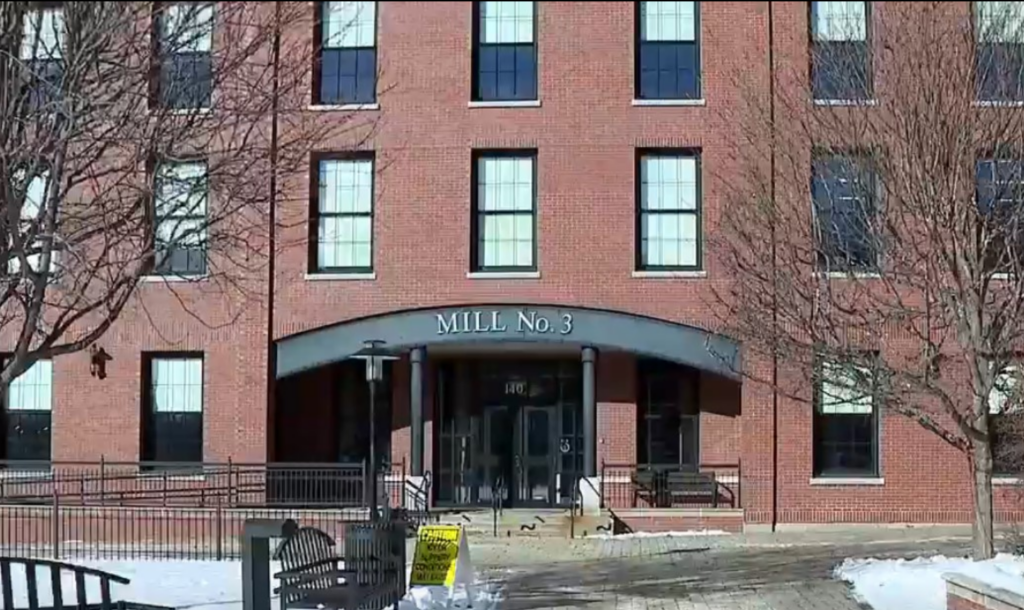
The Millcompute AI Data Center Proposal—and Why Lewiston Should Say No
Lewiston Has Seen This Story Before. We Should Not Repeat It.
Millcompute AI has proposed an AI data center at the former Bates Mill site in Lewiston. I grew up in Lewiston and still have family there. My mother, Lucille Blais-Barrett, worked as the top stitcher at Bates for more than 50 years. I worked there myself the summer before I went to college. After my father died, my mother’s mill job supported my brother and me until we were on our own two feet. Like many Lewiston families, ours depended on the mills—and we paid a price.
My father and all of his siblings died prematurely of cancer after years of exposure to the Rumford paper mills and Lewiston textile mills. This story is not unique. Across Maine, mill jobs sustained families while quietly damaging workers’ health, polluting rivers and air, and exporting wealth elsewhere. (Read Kerri Arsenault’s Mill Town) When the mills automated or shut down, communities were left with contaminated sites, lost livelihoods, and fragile local economies.
That history matters now, because the Millcompute proposal follows the same extractive pattern—just with different machinery.
The project would convert a historic industrial complex into a high-energy AI data center, supported by long-term tax abatements and public infrastructure, and powered by large amounts of electricity and cooling water. Supporters describe it as economic development that would reuse an old mill site and put Lewiston “on the map” in the growing AI economy.
But the financial promise deserves scrutiny. Under the proposed Tax Increment Financing agreement, an estimated 85–90% of property taxes paid by the developer would be returned to the company for up to 20 years. In other words, Lewiston would shoulder infrastructure and opportunity costs while retaining only a fraction of the revenue. Meanwhile, AI data centers typically create very few permanent local jobs once construction is complete—often dozens, not hundreds—while consuming enormous amounts of energy and water. Neither does an office upstairs from a hot, noisy data center attract new tech office workers.
This is not a clean break from Maine’s past. It is a continuation of it.
Maine’s extractive cycle began when rivers were dammed for hydropower, enclosing a shared commons to fuel industrial growth elsewhere. Textile and paper mills followed, promising prosperity while extracting labor, forests, and water, polluting air and rivers, and centralizing wealth outside the region. AI data centers follow the same logic: public subsidy, private ownership, minimal employment, heavy resource use, and decision-making removed from local control. The technology has changed, but the underlying model has not. Lewiston risks once again becoming a resource colony—this time for digital infrastructure instead of cloth or paper.
There are also broader concerns. AI data centers dramatically increase regional energy demand at a time when Maine needs power for housing, local businesses, and climate resilience. They lock communities into centralized, energy-intensive systems just as we should be investing in efficiency, sufficiency, and locally owned renewables. And they divert attention and capital away from development strategies that actually strengthen community well-being.
Fortunately, Lewiston already has better examples to follow. As the Lewiston Sun Journal has reported, the Bates Mill district is seeing major housing revitalization, and the Choice Neighborhoods initiative is bringing hundreds of new affordable and mixed-use units to downtown. These projects prioritize people who live here, address real needs, and keep benefits local. Likewise, plans to overhaul Simard-Payne Park and enhance riverfront public space point toward a future where the Androscoggin is a shared asset again, not an industrial afterthought.
Lewiston does not need another extractive industry disguised as innovation. We need development that builds durable livelihoods, protects health, restores ecosystems, and keeps wealth circulapting locally—through housing, green infrastructure, community-owned energy, small-scale manufacturing, education, and the arts.
The proposed AI data center is a tech Trojan horse. Millinocket recently recognized this and declined a similar proposal. Lewiston should do the same. We have lived this story before. This time, we can choose a different ending—one grounded in resilience, democracy, and a healthier future for our families.
Associate Prof. Joline Blais
School of Computing & Information Science
University of Maine
Joline Blais is a Maine-based researcher and educator focused on regenerative design, tech ethics, digital storytelling, and permaculture at the University of Maine’s School of Computing & Information Science. Her work bridges ecological practice, community resilience, and critical responses to harmful tech development.