
When military data becomes market advantage
The administration’s vacillating messaging on the Iran war has been variously explained as tactical brinksmanship, a disinterest in long-term planning, or a sign of cognitive decline. But in recent weeks, attention has shifted to a more insidious possibility: insider trading operating at network speed.
As covered in a previous essay, suspiciously timed bets in prediction markets like Kalshi and Polymarket suggest actors linked to the current administration may be trading on insider knowledge to reap hundreds of thousands of dollars—and possibly even influence military actions. These platforms, built for real-time speculation with anonymous cryptocurrencies, allow information to be monetized within seconds of its circulation. This week, parallel spikes appeared in more traditional markets, with algorithmic trades firing just ahead of official announcements.
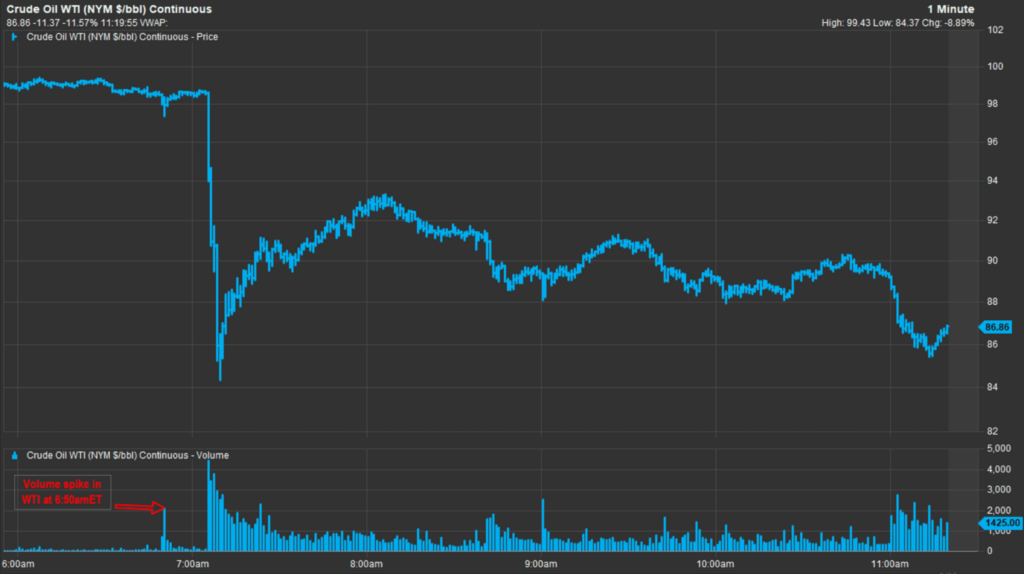
For a single pre-market minute on March 23 at 6:50am—with no public updates crossing the news wires—S&P 500 futures trading surged to $1.5 billion in notional value, while oil futures spiked far above normal levels with $580 million worth of contracts sold. Fifteen minutes later, Trump announced a surprise de-escalation of his attack on Iran’s oil infrastructure, sending equities soaring and oil prices plunging. In an era of machine-driven markets, such bursts can reflect automated systems reacting to signals invisible to the public.
Who would be in a position to exploit such insider intel in a hyperconnected environment? Robert Reich notes that Trump’s son-in-law Jared Kushner, one of the people representing the U.S. in negotiations with Iran, also runs a private-equity firm with $6 billion in investments funded by sovereign wealth funds based in Saudi Arabia and other oil-rich Gulf states. Another negotiator is Steve Witkoff, who has his own investment firm. Both operate within financial ecosystems where data, access, and capital move fluidly across borders and platforms.
Despite the obvious signs that someone was cashing in on advance knowledge of military decisions, no visible SEC investigation has followed, reinforcing concerns that enforcement has been blunted just as digital tools have multiplied the avenues for insider profiteering. On prediction markets, meanwhile, the pseudonymity of cryptocurrency wallets makes it difficult to trace transactions or link activity to specific individuals, whether public or private.
These anomalies in the oil markets coincided with a week of regulatory retreat. Trump-appointed leadership at the U.S. Securities and Exchange Commission has tightened political control over the agency’s investigations, requiring commissioners’ approval for formal inquiries. This shift comes at a moment when oversight must contend not just with traditional trades, but with encrypted messaging, decentralized finance, and globally distributed exchanges. It apparently precipitated the abrupt resignation on March 16 of the SEC’s enforcement chief Margaret Ryan, who was actively pursuing cases tied to the president’s circle like Justin Sun and Elon Musk.
Taken together, these signals suggest a pattern of corruption adapted to the digital age: government leaders profiting from insider knowledge that can now be transmitted, acted upon, and obscured in real time. In the case of prediction markets, actors may even be steering political decisions and timing to align with private payoffs executed through code. There’s a scene in Catch-22 in which an American logistics officer makes a deal with the Nazis to bomb a U.S. airfield in Italy to secure profit on both sides. Meant as absurdist satire, Joseph Heller’s novel now reads less like exaggeration and more like a precursor to a world where logistics, finance, and communication are tightly integrated systems.
A functioning democracy depends on separating public decisions from private gain. But when policy signals can propagate instantly through encrypted channels, trigger automated trades, and settle in opaque financial systems, that boundary becomes harder to maintain. Left unchecked, this convergence of governance and real-time markets risks turning public policy into just another stream of tradable data.
Image: suspicious trades before Iran war announcements on the West Texas Intermediate oil futures exchange, 23 March 2026. Source: CNBC.
(A version of this story originally appeared in the Crimson Goes Blue newsletter.)